Helping or Enabling? How to Tell the Difference When You Love Someone in Addiction
Jun 26, 2026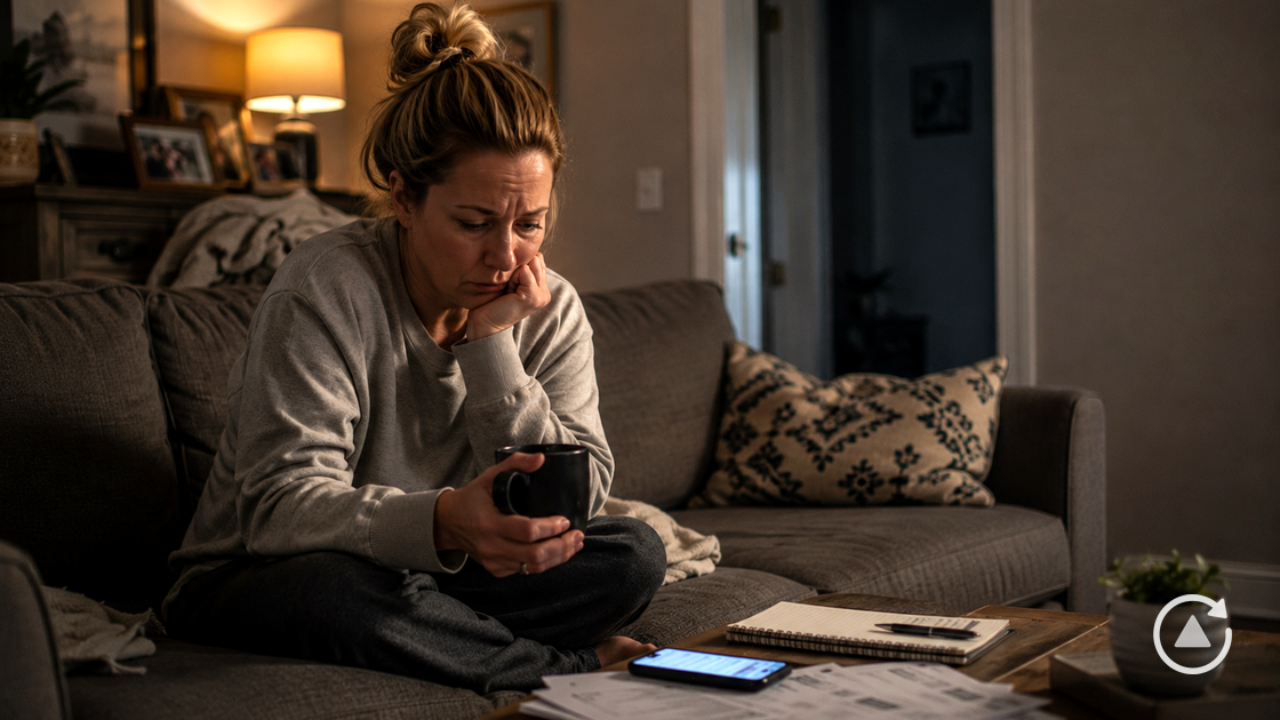
It usually starts with something small and loving. You pay the phone bill so they can stay reachable. You call their boss and say they have the flu. You cover rent one more month, you hire the lawyer, you smooth it over, you clean it up. Every single time, you do it because you love them and you cannot stand to watch them suffer.
And then one night, often around 2am, a quieter question shows up. Am I actually helping? Or am I making this worse?
If you have asked yourself that, you are not a bad person, and you are not failing. You are paying attention. This post is about the line between helping and enabling, why that line is so hard to see, and how to tell which side of it you are standing on right now.
First, what enabling actually means
Enabling has become a loaded word, and most people hear it as an insult. It is not. The cleanest working definition comes from Briana Sefcik, one of the clinicians in our course: enabling is doing something for someone that they absolutely can and should be doing for themselves. It is stepping in to provide a safety net between a person and the natural consequences of their own choices.
That is it. It has nothing to do with being weak, foolish, or naive. Some of the most capable, loving, intelligent people you will ever meet are world-class enablers, precisely because they are capable and loving. They see a problem and they fix it. That instinct serves you everywhere else in life. With addiction, it quietly works against you.
Why enabling is so hard to see: it comes from love
Here is the part that makes this so confusing. As Bri puts it, "enabling is absolutely done from the intent of love." There is almost never malice in it. You are not trying to keep anyone sick. You are a good person who does not want to watch someone you love be destroyed by this disease, so you do what any loving person would do. You protect them.
You call the boss and say they are out with the flu. You tell your friends they cannot make it tonight because of a family thing. You hire the attorney to keep the charges from sticking. Each of those choices is love in action. And underneath each one, without anyone meaning for it to happen, the same thing occurs: the person is shielded from the consequence that might have woken them up.
Saying this out loud is not an accusation. It is closer to permission to forgive yourself for what you did not know. You were never handed a guidebook for this. Nobody is.
The trouble is what the rescuing does over time. When someone is caught every time they fall, there is no reason for them to stop falling. There is an old recovery saying that families come to know well: people change when they get sick and tired of being sick and tired. If a loved one is comfortable, if every crisis gets absorbed by someone else, that moment of "I cannot keep living like this" keeps getting pushed further down the road. Without meaning to, we can prolong the very thing we are desperate to end.
The part almost nobody tells you
There is a second layer to enabling that is harder to admit, and it is worth sitting with honestly. A lot of the rescuing is not only about them. It is also about us.
When you swoop in and make it okay, you are managing your own fear and discomfort too. The logic runs underneath everything, mostly out of sight: if he is okay, then I am okay. If I can keep her safe, then I do not have to feel this unbearable thing in my chest. That is the heart of codependency, where your own sense of okayness is hooked entirely to another person's behavior.
Naming this is not something to feel ashamed of. It is the opposite. You cannot change a pattern you cannot see, and seeing that some of your helping is really self-protection is one of the most freeing things you can do. It means the work in front of you is not just about them. It is also about learning to be okay even when they are not, which is the only ground solid enough to stand on through this.
A simple test: four questions
When you are genuinely unsure whether something is help or enabling, run it through these four questions. None of them is designed to make you the villain. They are just a flashlight.
- Can they do this themselves? If the honest answer is yes, doing it for them leans toward enabling.
- Am I shielding them from a consequence they created? Cleaning up a mess that would otherwise teach them something usually crosses the line.
- Is this serving the disease, or their recovery? Same act, very different purpose. One keeps things comfortable. The other points toward change.
- Am I doing this out of love, or out of fear? Love can wait, set a limit, and tell the truth. Fear rescues. Fear-driven rescuing is almost always enabling.
You will not get a clean answer every time, and that is fine. The point is not a perfect score. The point is to start seeing your own choices clearly.
Helping versus enabling, in real life
The same action can be help in one moment and enabling in the next, depending on the why behind it and what happens after. Still, some patterns show up again and again.
Choices that often tip into enabling: handing over cash with no idea where it goes, paying for the consequences over and over (the bail, the fines, the tickets, the lawyers), lying to employers or family to cover for them, bending every house rule to keep the peace, and quietly taking on their responsibilities, from their job to their bills to their kids.
Choices that tend to be genuine help: offering to research treatment options and levels of care, driving them to a meeting or an appointment, making a meal, listening without rushing to fix, telling the truth kindly even when it is hard, and taking real care of yourself so you can stay in this relationship for the long haul.
Notice that the helping list is not cold or distant. It is full of presence and support. The difference is that it points toward recovery instead of cushioning the disease.
The hard truth that actually sets you free
There is one truth in all of this that is painful to hear and, strangely, the thing that frees people the most. You are not powerful enough to keep the worst from happening, no matter how much you rescue.
That is brutal, and it is also the doorway out. You can contribute to the solution, which is exactly what you are doing by reading this. But you cannot fix it all by yourself, and you cannot love someone into recovery through sheer force of effort. One family member said it in a way that has stuck with us: I cannot fix it, but I can get in the way of it getting fixed.
That is the whole reframe. The goal was never to stop loving them or to go cold and walk away. The goal, as our expert Corbin Bigheart describes it, is to stop enabling the disease and start enabling recovery. Same love, aimed in a direction that actually helps.
What to do instead
Shifting out of enabling is not a single decision. It is a slow, supported change of pattern. A few places to begin:
Let natural consequences happen, carefully and not cruelly. You do not have to engineer pain. You only have to stop absorbing the consequences that were never yours to carry.
Replace rescuing with support that points toward recovery. Offer treatment information. Offer a ride to a meeting. Offer your steady presence. Stop offering the buffer that keeps the disease comfortable.
Set boundaries you can actually keep. A boundary you will not enforce is not a boundary, it is a wish. (If this is where you feel stuck, our post on setting boundaries with a loved one in addiction walks through how to build ones that hold.)
Get your own support, and do not do this alone. One of the cruelest parts of this disease is how isolating it becomes. Well-meaning friends tell you exactly how to handle it, the advice does not fit, and slowly you stop talking to anyone. Al-Anon, a good therapist, and a structured course like this one exist so that you are not the only adult in your life carrying this.
Be gentle with yourself. You enabled because you loved someone and no one taught you another way. That is not a character flaw. That is being human in an impossible situation.
You are allowed to change your part
You did not cause your loved one's addiction, you cannot control it, and you cannot cure it. But you can change the part you play in it. That is not a small thing. It is, quietly, one of the most powerful things available to you, because your part is the only part that has ever been yours to change.
If today all you did was ask whether you might be enabling, you already started. That honesty is the beginning of a different pattern.
A free first step
If you want a place to begin that does not cost anything, download the free Recovery Road Map workbook at changethepattern.life/workbook. It is a short, guided exercise to help you see your own situation more clearly and take the first step toward taking care of yourself while you support someone you love.
Change the Pattern is a self-paced course for the family members and loved ones of someone struggling with addiction, created and hosted by Michael Smeltzer, who has worked in behavioral healthcare for over a decade and has been in recovery for more than a decade himself.